Writing is hard.
It’s not laying bricks or open-heart surgery, but it is definitely challenging. It’s made doubly challenging when you’re trying to make a regular habit of it. The conventional wisdom is that you have to exercise it like a muscle, right? Do it consistently, and eventually, it gets easier. But getting through the mushy middle to the point of consistency can be tricky.
For times like these, I invoke the humble Inspiration Board.
What is an Inspiration Board?
At its most basic level, and inspiration board is a visual representation of your story. A lot of times, the germ of a story comes from a vibe or a line from a song or an image- one tiny speck of nothing that blooms in your mind into an idea you can’t let go. The inspiration board seeks to capture that, so you can access it whenever the excitement starts to wane. It’s how you rekindle that initial spark.
It can also help play with new ideas- things you want to try, ideas you don’t have a place for yet but that you don’t want to forget, other vibes or images that tickle the same place in your brain as the originals.
What goes on an Inspo Board?
So, I do have a template I use for my normal Inspo boards, and I will post it here for you.
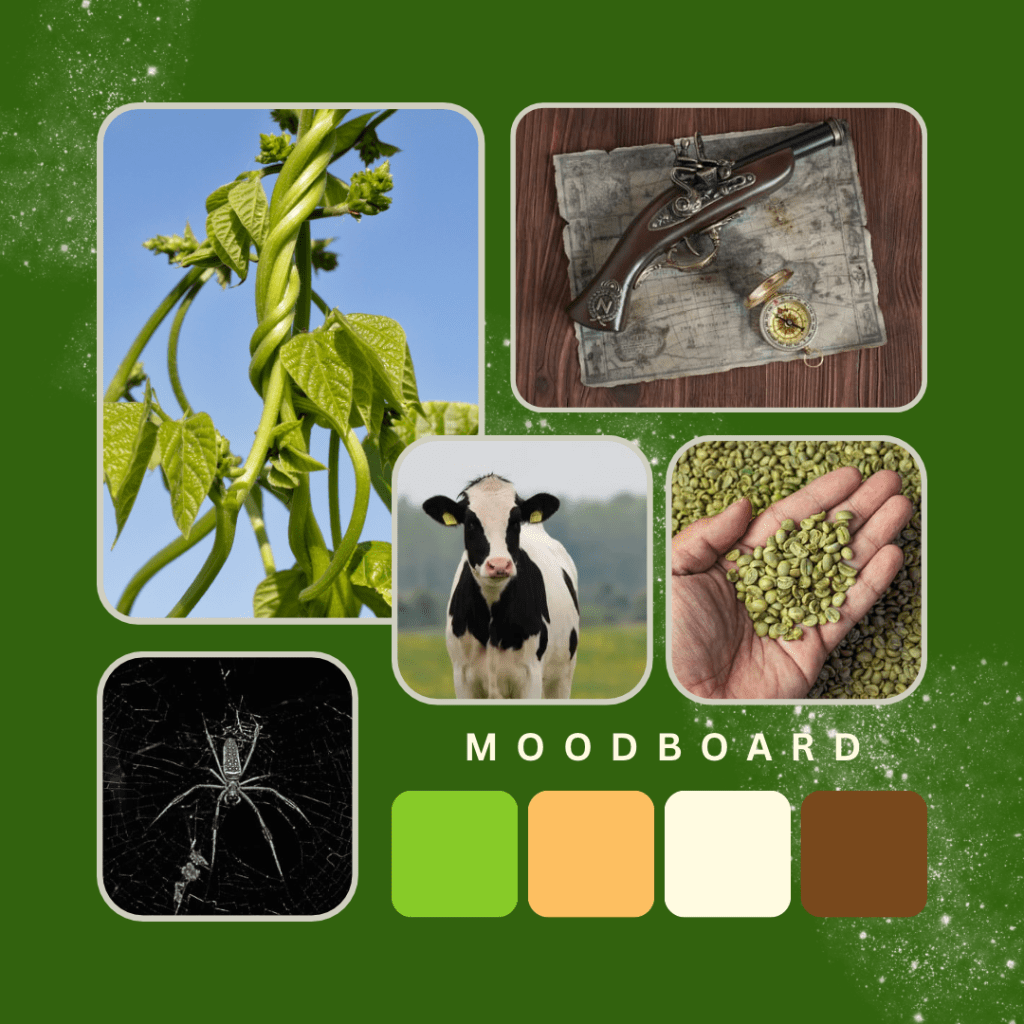
However, there are a number of different styles of boards. Mood boards, inspo boards, 5 year plans, dream boards, vision boards, motivation boards. There is obviously a lot of overlap between the different types, so knowing which kind you need is important.
This might sound like a bit of a departure, but stay with me: why do you want to write? And follow up: what do you want to write? Finding your why and your what will help you with your how.
Writing for yourself and writing for a career are totally different beasts. If you’re writing for a more informal context, you can base your board around vibes. Focus on colours and textures and tone. If you’re hoping to publish, you have to be quite a bit more detailed and specific.
Where to Find Your Images
Again, this depends on your needs. If it’s just for you, Google Images is great. If you’re hoping to show it to the public, be aware of the ethics of sharing images and get familiar with copyright laws.
The best source is hand drawn art, either by yourself or another human. I am 100% of the stance that AI art is theft. Just to get that out of the way.
If you’re not a good enough artist for your needs and can’t afford to pay someone, don’t discount stock photo archives. Here is a list of great image sources. And there’s nothing wrong with using an image with a watermark. It doesn’t look as nice, but it’s a way to get a perfect image for free.
Ok, Now You Have Your Board, How Do You Use It?
There are a few uses for these boards. The main one is to inspire you, to keep your excitement high, to keep your mind sharp.
You can also use it to introduce your work. You can send it to your betas to make sure your finished wip matches the vibe you were going for.
You can also use it for marketing. You have a built-in brand package, from colours to symbols, from original or stock art to mood. You might have already included comparisons to other similar works. You can use it as a launching point for an ad campaign or cover design, you can even share it around in its raw form to drum up interest.
~~~~
So why are you interested in Inspo boards? What sort of things will you be sticking on yours?
 Avon Van Hassel