

Traditionally, I like to have a recipe in December, to leave the year on something tasty.
Once upon a time, I had a mind to put some historical cooking videos on YouTube.
I started with a base recipe taken from Hannah Glasse’s The Art of Cookery, Made Plain and Easy. It was beautiful, I was very proud of it, but I did not do the job of set dressing that I should have, and I had to take it down. A running joke throughout was how much I wanted a pressure canner so I could can the gravy and use it later. Well, I have the canner now. What do you guys think of me taking another stab at historical cooking videos?
That’s it for me for the requisite pre-recipe preamble. On to the show!
~This post contains affiliate links. If you’re interested in any of these items, please consider purchasing through the link provided. It gives me a little bit of Jeff Bezos’ filthy, filthy lucre because writing full time is expensive, and he doesn’t need the money for more joyrides in space. 🙂 ~
So, at the beginning of Book 4, coming out soon, hopefully, Johanne reluctantly hosts a dignitary at Parry House, and during dinner, FOR PLOT REASONS, a lot of dishes feature almonds, in some way. The dish in the lineup I was most enchanted by was a sweet and spiced marrow pudding. In December of 2022, I did try it, but I was struggling to find the correct kind of puff pastry, so I had to adapt and it came out all wrong, so this year, I’m determined to do it properly.
To make a Marrow Pudding, Hannah Glasse, The Art of Cookery, Made Plain and Easy, 1747:
Take a quart of cream or milk, and a quarter of a pound of Naples biscuit, put them on the fire in a stew-pan, and boil them up; then take the yolks of eight eggs, the whites of four beat up very fine, a little moist sugar, some marrow chopped, a small glass of brandy and sack, a very little orange-flower-water; mix all well together, and put them on the fire, keep it stirring till it is thick, and put it away to get cold; then have ready your dish rimmed with puff-paste, put your stuff in, sprinkle some currants that have been well washed in cold water, and rubbed clean in a cloth, some marrow cut in slices, and some candied-lemon, orange, and citron, cut in shreds, and send it to the oven; three quarters of an hour will bake it: send it up hot.
Translation:
- 4 cups milk or cream or half and half
- 7oz package of ladyfinger cookies
- 8 eggs
- 1.5 T brown sugar
- 2 marrow bones
- 2 oz brandy and sherry mixed
- 1T orange blossom water or 2t orange blossom flavouring
- 1/2 package of frozen puff pastry
- 1/2 cup currants, soaked overnight
- Candied citrus peel for garnish
- Heavy cream (optional)
- Candied rose petals (optional)
- Sliced almonds (optional)
- 1T Marzipan (optional)
Prep
- Soak currants in water for at least 3 hours, preferably overnight. Dry well with a cloth.
How To Process Marrow Bones
- If you have frozen bones, thaw first for a few hours. Then bake the bones at 350F for 20 mins, or until the marrow goes translucent and gooey.
- Scoop marrow out of bones. Cut half into strips and roughly chop the other half. *Hannah doesn’t specify how much marow, but I find that a tablespoon or so of cooked marow is enough to add the richness without imparting too much flavour, which I did not find to my taste.*
To Make the Pudding
- In a large pot on the stove, combine ladyfingers and milk or cream and bring to a boil. Add optional 1 T of marzipan. Once dissolved, turn off heat and let sit.
- Separate eggs. Whip 4 whites until soft peaks form, save the remaining whites aside for use later. (Perhaps sugared rose petals?) Combine whipped egg whites with all 8 egg yolks.
- To the eggs, add the sugar, liquor, flavouring, and chopped marrow.
- Add egg and marrow mixture to the ladyfingers and cream. Mix well.
- Heat and stir until very thick. Turn off heat and let cool completely. Do not walk away from it, keep stirring until it’s thick and jiggly.
- Thaw puff pastry 30 mins to an hour.
- Heat oven to 375*F.
- Roll out puff pastry and line a deep pie dish.
- The original recipe says to fill the dish with the filling then sprinkle the fruits on top and the slices of marow, but I like the fruits mixed in. Do as you like, but I would reccommend still laying the slices of marrow on top, there’s enough marrow mixed into the filling already.
- Bake for 45 mins, or until a toothpick comes out clean.
- Serve immediately, I recommend with a little cream drizzled on top.
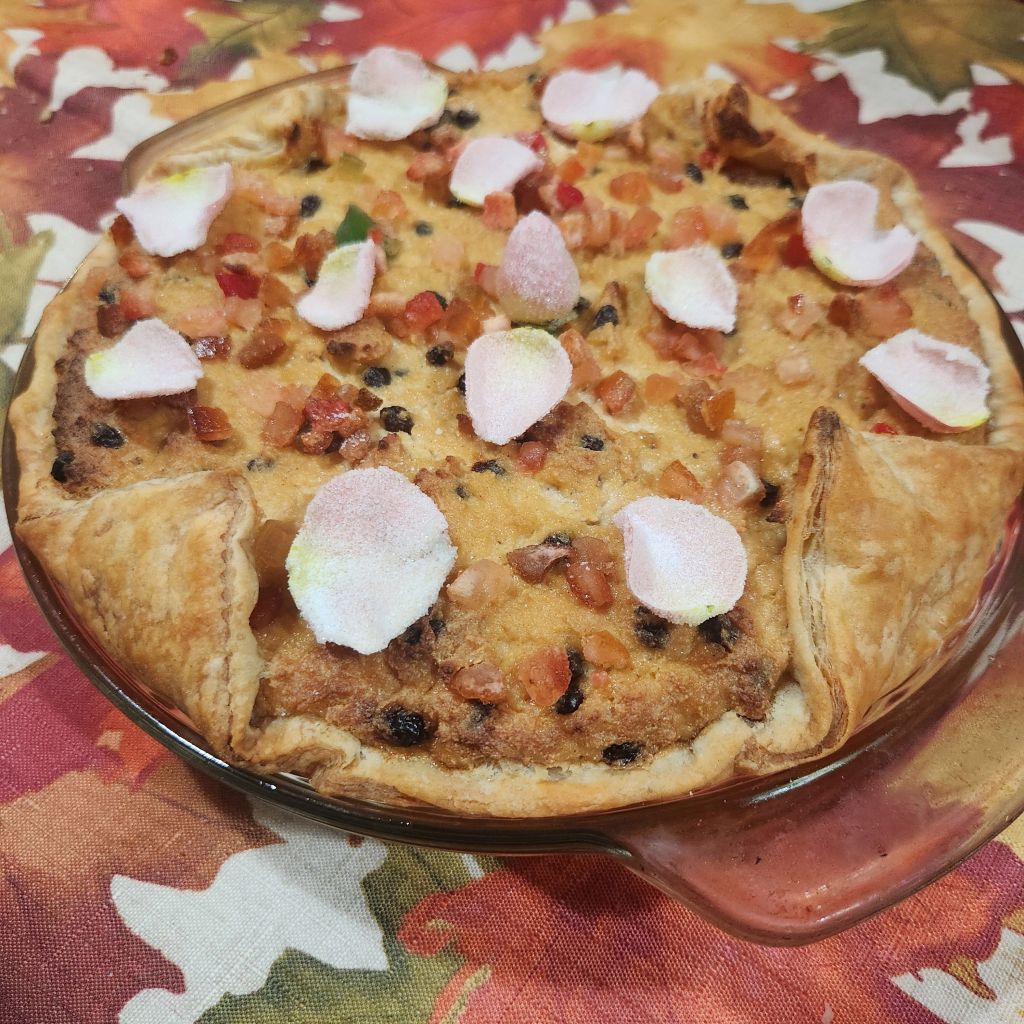
- To make it book-accurate to my story, you could add soft marzipan to the filling, add sliced almonds on top before baking, and garnishing with candied rose petals when it comes out and the top is still tacky.
- To make candied rose petals, paint rose petals with egg whites with a little paintbrush, then dredge in sugar and let dry for at least 4 hours
- I chose not to add the sliced marrow or almonds on top for the photo, because my family didn’t like the taste of the marrow and I hate almonds lol
~~~
I asked my parents for honest reviews, and my mother said that it tastes like only the ultra wealthy would have access to it.
Though Hannah Glasse aimed her book at the average (middle class) woman, this recipe assumes that its reader has a certain amount of money and a certain amount of skill- or access to it.
- The ability to make puff pastry and Naples biscuits, which I certainly don’t have (thank goodness I live in an age where I can buy them easily), and which requires A LOT of butter, so you have to just have that much butter in your kitchen.
- It also requires sherry (which comes from Spain)
- brandy (most likely from France)
- orange blossom water and candied citrus peel (oranges don’t grow well in the UK)
- and moist sugar (which means brown sugar, and sugar came from the Americas)
So right off the bat, a lot of skill and a lot of money is required to make this. I think Mrs Glasse assumes that her audience either has a cook for her household or is a cook in a large house. Possibly even a pastry chef. Also, I assume that much cream and eggs (with the option to discard that many egg whites) implies access to a cows and chickens, which both require land. So at the very least, her ideal reader is a very comfortable farmer’s wife, who has a servant who has some schooling in pastry techniques.
I made this recipe a few times, to perfect it not only linguistically for a modern reader, but for my own taste and to make it book accurate; and every time I did it, I learned something new. I had to keep adjusting down. For instance, to me, when I heard to beat eggs up very fine, I think stiff peaks. But can you achieve stiff peaks by hand? I can’t. Granted, I’m not a professional chef, and my upper body strength is a joke. But how much can we reasonably expect?
Also, stove and oven temperature? This recipe was written for a wood burning stove and oven, which only get so hot, and not consistently so.
Measurement? Who is she?
So, I had to put myself, to the best of my ability, in the mind and body of a woman from the past, measuring out her moist sugar, and deciding at what temperature I had to get my oven so that that much custardy biscuit would cook in 45 minutes, because Mrs Glasse chose that to be precise about, for some reason, instead of just cooking it until a knife comes out clean.
The inclusion of the marrow still baffles me, though, so maybe a more learned chef than me can answer. It can’t be for fat, because there’s already so much egg yolk and cream, and puff pastry. It can’t be for protein because there is so much egg and also the biscuits give it structure. It’s not for flavour, with that much liquor and orange blossom water. It’s an essential part of the recipe, lending itself to the title, yet the amount present is not specified. So, what do you think?
~~~~
If you try this out, please post pics online and tag me, or leave a comment!
 Avon Van Hassel