Avon Van Hassel

Building Worlds and Filling Them With Magic

Traditionally, I like to have a recipe in December, to leave the year on something tasty.

Once upon a time, I had a mind to put some historical cooking videos on YouTube.

I started with a base recipe taken from Hannah Glasse’s The Art of Cookery, Made Plain and Easy. It was beautiful, I was very proud of it, but I did not do the job of set dressing that I should have, and I had to take it down. A running joke throughout was how much I wanted a pressure canner so I could can the gravy and use it later. Well, I have the canner now. What do you guys think of me taking another stab at historical cooking videos?

That’s it for me for the requisite pre-recipe preamble. On to the show!

~This post contains affiliate links. If you’re interested in any of these items, please consider purchasing through the link provided. It gives me a little bit of Jeff Bezos’ filthy, filthy lucre because writing full time is expensive, and he doesn’t need the money for more joyrides in space. 🙂 ~

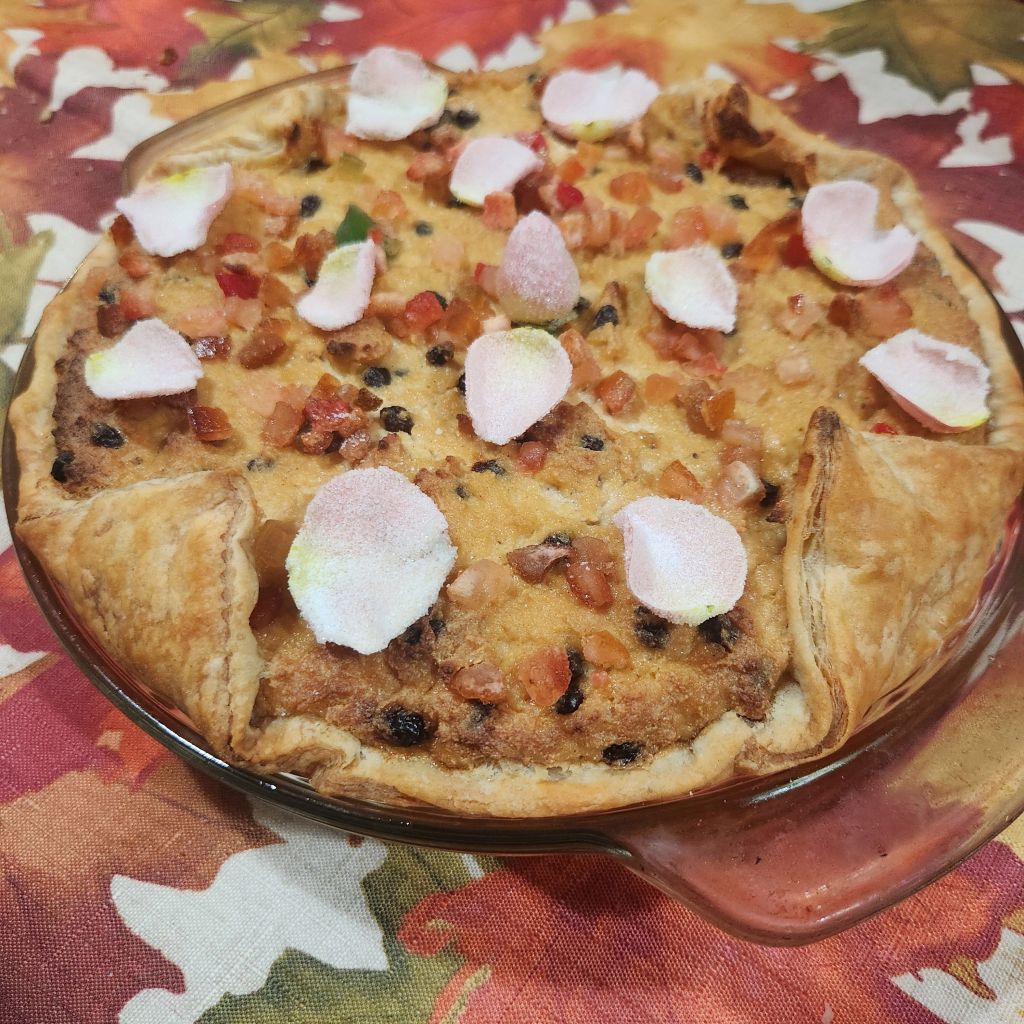
So, at the beginning of Book 4, coming out soon, hopefully, Johanne reluctantly hosts a dignitary at Parry House, and during dinner, FOR PLOT REASONS, a lot of dishes feature almonds, in some way. The dish in the lineup I was most enchanted by was a sweet and spiced marrow pudding. In December of 2022, I did try it, but I was struggling to find the correct kind of puff pastry, so I had to adapt and it came out all wrong, so this year, I’m determined to do it properly.

To make a Marrow Pudding, Hannah Glasse, The Art of Cookery, Made Plain and Easy, 1747:

Take a quart of cream or milk, and a quarter of a pound of Naples biscuit, put them on the fire in a stew-pan, and boil them up; then take the yolks of eight eggs, the whites of four beat up very fine, a little moist sugar, some marrow chopped, a small glass of brandy and sack, a very little orange-flower-water; mix all well together, and put them on the fire, keep it stirring till it is thick, and put it away to get cold; then have ready your dish rimmed with puff-paste, put your stuff in, sprinkle some currants that have been well washed in cold water, and rubbed clean in a cloth, some marrow cut in slices, and some candied-lemon, orange, and citron, cut in shreds, and send it to the oven; three quarters of an hour will bake it: send it up hot.

Translation:

  • 4 cups milk or cream or half and half
  • 7oz package of ladyfinger cookies
  • 8 eggs
  • 1.5 T brown sugar
  • 2 marrow bones
  • 2 oz brandy and sherry mixed
  • 1T orange blossom water or 2t orange blossom flavouring
  • 1/2 package of frozen puff pastry
  • 1/2 cup currants, soaked overnight
  • Candied citrus peel for garnish
  • Heavy cream (optional)
  • Candied rose petals (optional)
  • Sliced almonds (optional)
  • 1T Marzipan (optional)

Prep

  1. Soak currants in water for at least 3 hours, preferably overnight. Dry well with a cloth.

How To Process Marrow Bones

  1. If you have frozen bones, thaw first for a few hours. Then bake the bones at 350F for 20 mins, or until the marrow goes translucent and gooey.
  2. Scoop marrow out of bones. Cut half into strips and roughly chop the other half. *Hannah doesn’t specify how much marow, but I find that a tablespoon or so of cooked marow is enough to add the richness without imparting too much flavour, which I did not find to my taste.*

To Make the Pudding

  1. In a large pot on the stove, combine ladyfingers and milk or cream and bring to a boil. Add optional 1 T of marzipan. Once dissolved, turn off heat and let sit.
  2. Separate eggs. Whip 4 whites until soft peaks form, save the remaining whites aside for use later. (Perhaps sugared rose petals?) Combine whipped egg whites with all 8 egg yolks.
  3. To the eggs, add the sugar, liquor, flavouring, and chopped marrow.
  4. Add egg and marrow mixture to the ladyfingers and cream. Mix well.
  5. Heat and stir until very thick. Turn off heat and let cool completely. Do not walk away from it, keep stirring until it’s thick and jiggly.
  6. Thaw puff pastry 30 mins to an hour.
  7. Heat oven to 375*F.
  8. Roll out puff pastry and line a deep pie dish.
  9. The original recipe says to fill the dish with the filling then sprinkle the fruits on top and the slices of marow, but I like the fruits mixed in. Do as you like, but I would reccommend still laying the slices of marrow on top, there’s enough marrow mixed into the filling already.
  10. Bake for 45 mins, or until a toothpick comes out clean.
  11. Serve immediately, I recommend with a little cream drizzled on top.
  • To make it book-accurate to my story, you could add soft marzipan to the filling, add sliced almonds on top before baking, and garnishing with candied rose petals when it comes out and the top is still tacky.
  • To make candied rose petals,  paint rose petals with egg whites with a little paintbrush,  then dredge in sugar and let dry for at least 4 hours
  • I chose not to add the sliced marrow or almonds on top for the photo, because my family didn’t like the taste of the marrow and I hate almonds lol

~~~

I asked my parents for honest reviews, and my mother said that it tastes like only the ultra wealthy would have access to it.

Though Hannah Glasse aimed her book at the average (middle class) woman, this recipe assumes that its reader has a certain amount of money and a certain amount of skill- or access to it.

  • The ability to make puff pastry and Naples biscuits, which I certainly don’t have (thank goodness I live in an age where I can buy them easily), and which requires A LOT of butter, so you have to just have that much butter in your kitchen.
  • It also requires sherry (which comes from Spain)
  • brandy (most likely from France)
  • orange blossom water and candied citrus peel (oranges don’t grow well in the UK)
  • and moist sugar (which means brown sugar, and sugar came from the Americas)

So right off the bat, a lot of skill and a lot of money is required to make this. I think Mrs Glasse assumes that her audience either has a cook for her household or is a cook in a large house. Possibly even a pastry chef. Also, I assume that much cream and eggs (with the option to discard that many egg whites) implies access to a cows and chickens, which both require land. So at the very least, her ideal reader is a very comfortable farmer’s wife, who has a servant who has some schooling in pastry techniques.

I made this recipe a few times, to perfect it not only linguistically for a modern reader, but for my own taste and to make it book accurate; and every time I did it, I learned something new. I had to keep adjusting down. For instance, to me, when I heard to beat eggs up very fine, I think stiff peaks. But can you achieve stiff peaks by hand? I can’t. Granted, I’m not a professional chef, and my upper body strength is a joke. But how much can we reasonably expect?

Also, stove and oven temperature? This recipe was written for a wood burning stove and oven, which only get so hot, and not consistently so.

Measurement? Who is she?

So, I had to put myself, to the best of my ability, in the mind and body of a woman from the past, measuring out her moist sugar, and deciding at what temperature I had to get my oven so that that much custardy biscuit would cook in 45 minutes, because Mrs Glasse chose that to be precise about, for some reason, instead of just cooking it until a knife comes out clean.

The inclusion of the marrow still baffles me, though, so maybe a more learned chef than me can answer. It can’t be for fat, because there’s already so much egg yolk and cream, and puff pastry. It can’t be for protein because there is so much egg and also the biscuits give it structure. It’s not for flavour, with that much liquor and orange blossom water. It’s an essential part of the recipe, lending itself to the title, yet the amount present is not specified. So, what do you think?

~~~~

If you try this out, please post pics online and tag me, or leave a comment!

What it is

In November, I usually post something about National Novel Writing Month. For the uninitiated, National Novel Writing Month, or NaNoWriMo, is a month-long event where participants write a 50,000 word long novel from start to finish. However, in light of recent criticism regarding misconduct within their organisation aimed at kids, and their recent stance on AI, I can no longer affiliate myself with the Office of Letters and Light. If you still like the challenge and the community, let me know, and I will see if I can set something up next year.

~This post contains affiliate links. If you’re interested in any of these items, please consider purchasing through the link provided. It gives me a little bit of Jeff Bezos’ filthy, filthy lucre because writing full time is expensive, and he doesn’t need the money for more joyrides in space. 🙂 ~

So, without NaNo to talk about, how do I theme a writing post for November? November, here in the United States, is Thanksgiving season. Thanksgiving as a holiday is a sensitive subject, and becoming more and more delicate every year. In my own house, we put less focus on the accepted story and adopt the day as an opportunity to take stock of our good fortune in the passing year.

Let me be clear, we stand with the descendants of the indigenous people, whose stories differ wildly from the story we were told in school and around the Thanksgving table for generations. Columbus Day has been changed to Indigenous People’s Day, and I feel it won’t be long until National Day of Mourning is observed alongside Thanksgiving. I’m not sure it will ever fully replace it- we do love a food-based holiday in this country- but it is certainly gaining more visibility.

So, in the spirit of my family’s approach, I thought a good overlap between thankfulness and writing is gratitude journaling.

Why do it

Depression is on the rise. The Happiness Quotient is in the toilet. The political climate is dire across the world and we live in frightening times.

Yet, studies show that a gratitude practice can play a big role in maintaining our own personal peace. It helps, in the maelstrom of the daily stresses, social media mire, relentless news cycle, etc, to take a pause, recognise the blessings big and small in your own life, and focus on those. It won’t solve the hurts of the world, but it could, over time, make them more bearable. The world feels a little less hopeless when you can look around and recognise the happinesses you do posess.

And if all it does is make you feel better for one day, that’s still one day that sucked less.

Journalling also serves as a sort of record keeping. It keeps track of some things that you’ve done and felt. Milestones at work or in the home, social engagements, tracking progress with going to the gym or taking your meds.

When Cassie, my previous cat, was in decline, I knew it, and I wrote ‘another day with Cassie’ in my journal, most days. When she passed, I lamented that I didn’t make the most of my last months with her, I wasn’t ready for her to go and I didn’t appreciate her as I should have. But one day, I was going through past jorunal entries, looking for something, and I found the dozens and dozens of ‘another day with Cassie’s and I realised that I did appreciate her, I did know what was happening and I did make the most of it. It was just my grief in the moment robbing me of the memory of that gratitude. That helped my healing, a lot.

A lot of people see gratitude journalling as part of the Toxic Positivity movement, and that is shortsighted, in my opinion. Yes, negativity exists; yes, some situations suck, and there’s no way to candy-coat them. Gratitude journalling is not ignoring negativity, it is not stubbornly reframing tragedy as Good Actually. You can acknowledge that shit sucks right now, but also you had a good sandwich for lunch. Both things can be true.

We live in an environment where the negativity is So big and So pervasive that it’s difficult to ignore. I’m not asking you to. I’m asking you to give the good things some room to breathe so that the bad things aren’t the only things you see. This isn’t about tinting the world in a rosy filter, it’s about finding good things to cling to so that the bad things are more bearable. It’s self-preservation.

How to do it

There is literally no wrong way to do it. At its heart, it is just a list of things that make you happy or are net positives. They can be as big as having achieved your dream job or a loving family; or it can be as small as a really good cup of coffee and smooth traffic on the way to work.

Because I crave structure, my list is usually three things:

  • something I have (my new Shark Flexstyle, which I paid an absurdly low price for)
  • something I accomplished in the previous day (deep cleaned the kitchen)
  • a trait that either I or a friend exhibitted that helped me get through a challenge (my adaptability, Cristian’s stupid joke that improved my dark mood, etc)

I am the sort of person who self-soothes with retail therapy, so it helps to stop and remember the Really Cool and Good stuff I already have. Sometimes you forget you have certain things, so rediscovering them can feel like buying them anew. I am also the kind of person who can tie mental and emotional health directly to productivity and accomplishment, so aknowledging those things can help keep me grounded. And lastly, I feel it is important to note the invisible, intangible things- personal strengths and community ties. Remembering to take a breath instead of snapping at a customer, a friend who was there when you needed to vent, an extra minute of cuddle time with your pet. If you like, you can add a fourth category for things that happened to you- a random stroke of luck that worked out in your favour.

Avon, you say, you’re congratulating yourself on remembering to breathe. The bar is on the ground.

Yes. It is. That’s the point. We are so conditioned to always be aiming for bigger and better, to only celebrate the big wins, and discard the little ones. That is the road to burnout. You’ve seen those posts on social media that say ‘It’s ok if all you did today was survive’? I mean, when you have severe depression, that’s where the bar is. And, as the adage says, that’s ok. You have to start somewhere. With time, ‘survive’ becomes ‘got dressed,’ then ‘bought groceries,’ ‘cooked dinner,’ ‘went to work.’ Notice that there isn’t a timeline there, it just goes at its pace. The point is to be grateful, for anything, no matter how big or small.

Now, I don’t want you to list EVERYTHING, unless a long list is warranted. If you list everything you’re grateful for every single day, that’s going to be difficult to make a habit of- and the habit is the point. Additionally, listing the same things over and over dull their shine. You’re likely to have the same job for multiple entries, the same family, the same weather even. So try to mix it up, try to keep it on the short side; that encourages you to look for new things every day, and get the exercise done quickly so that it doesn’t interfere with your other obligations. The exception is if you’ve had a particularly exciting day.

I’m writing this post on the day after my 37th birthday, which I spent in Antigua, Guatemala. I am grateful for a lovely day yesterday, where:

  • I played with my Shark Flexstyle. My curls fell out immediately, but I had fun, all the same.
  • I had a cup of coffee on the roof of my family’s house, in the shadow of three volcanoes
  • Dad took me to breakfast at a coffee plantation
  • I went shopping for shoes, a purse, traditional candy, and some pretty jade jewelery
  • I had a long, quiet afternoon, listening to my Regency comedy romance audiobook and playing the Sims
  • My friend in Argentina and I shared an alfajor together over Instangram, which was super cute
  • Another friend told me that he had sent a parcel to my house
  • My mother messaged me pictures of my cat, Artemisia
  • Many friends wished me happy birthday
  • My cousin’s baby sang ‘Happy Birthday’ to me
  • A bunch of stores gave me enough birthday points for me to get a bunch of free stuff
  • Dad took me to a fancy dinner
  • I gave myself a mini facial and mani-pedi before bed

So, that’s more than three, but I had much to be grateful for, and I wanted to remember all of them, and they are individually unlikely to repeat, even on my birthday next year. Except the points from the companies, that’s automated.

My advice is to aim for three things every day, either in the evening or the following morning. Three things minimum, but less that five unless the situation calls for it. But you do what works for you, if you have the time and discipline to add more.

How to get fancy

Now, I know some of y’all are like, eww, a list. Some of us are busy ladies who crave structure and routine, but also get bored and want to be free. We’re basically cats.

But some of y’all are artistes, and the aesthetic is everything.

I assume by now that you’ve heard of bullet journals, but if you haven’t, they’re essentially a bullet list that you can adapt to any purpose, and you can make it as simple or complex as you want. There are blogs and YouTube videos, and social media accounts, and miles and miles of Pinterest boards to give you inspiration on how to set up, structure, fill, and decorate your journal. Make it your own.

Personally, I have a digital planner designed for people with ADHD (THOUSANDS of tabs, and endless personalisation options). The daily entries have spaces not only for gratitude journalling, but a section for the highlight of the day. It also has a whole tab for gratitude journalling specifically. I prefer digital planners, but there are physical ones (my therapist swears by this one), blank ones, already decorated ones. There’s even a fantasy quest-themed one that I also use. Stamps, stickers, coloured pens and markers, washi tape, highlighters. Creatives, you know what to do.

A prompt

So, how do you get started? I know I prefer a road map. The blank page is my ancient nemesis. So, here is your November 4 prompt:

Settle yourself somewhere comfortable and quiet. Take a deep breath and think back to yesterday, November 3. What was the weather like? What did you eat all day? Who did you talk to?

Don’t judge yourself, and try to frame everything you did as positive. If you only ate junk food, that’s still food and you kept yourself alive. If the weather was rainy and dull, that’s good for the earth and the air quality. If you only spoke to your pet, that still enforced that relationship. If you need to phrase things sarcastically at first, that’s ok. Once you get used to saying the words, eventually it will come more naturally and what started off sarcastic will become genuine.

It’s the practice that matters. Hang in there. Keep your chin up. You have more to be grateful for than you think.

The Legend of Sleepy Hollow is one of the oldest examples of homegrown American literature, and survives to this day as a staple of the Halloween, as distinct from horror, genre. It was written by Washinton Irving in 1820, as part of his compilation of a whole bunch of things (the 1800s was a very experimental time for literature),  The Sketch Book of Geoffrey Crayon, Gent.

~This post contains affiliate links. If you’re interested in any of these items, please consider purchasing through the link provided. It gives me a little bit of Jeff Bezos’ filthy, filthy lucre because writing full time is expensive, and he doesn’t need the money for more joyrides in space. 🙂 ~

Plot

1n 1790, a schoolteacher from Connecticut, Ichabod Crane, settles in Sleepy Hollow, a quiet little town near Tarrytown, a former Ducth colony in Upstate New York. He is tall and gangly, superstitious, sanctimonoius, greedy, and grasping. Think baby Ebenezer Scrooge, except Scrooge was ok in his youth. Ichabod started off that way. He meets Katrina Van Tassel, the only daughter of Baltus Van Tassel, one of the wealthiest landowners in the area. Yes, Katrina is a plump lil beauty, but it is made very clear early and often that Ichabod is lusting solely after her lands, and its associated animals (which he fantasizses about cooking) and the income it generates. He conspires to become her private tutor, which Baltus allows, but he runs afoul of Abraham Van Brunt, known as Brom Bones, the town jock, essentially, who seems to have a genuine and sincere interest in Katrina. Brom is unsuccessful in blocking Ichsabod from getting near Katrina, so begins a campaign of harassment.

You know that joke about how the A Song of Ice and Fire books are just like the show, except substitute all the sex for food? That’s The Legend of Sleepy Hollow, too. The scene where Ichabod fantasises about the Van Tassel livestock, and later, the scene where he is invted to the harvest festival at the Van Tassel house are just *chef kiss* I once wrote a blog post about the onion sauce he described. You’re welcome.

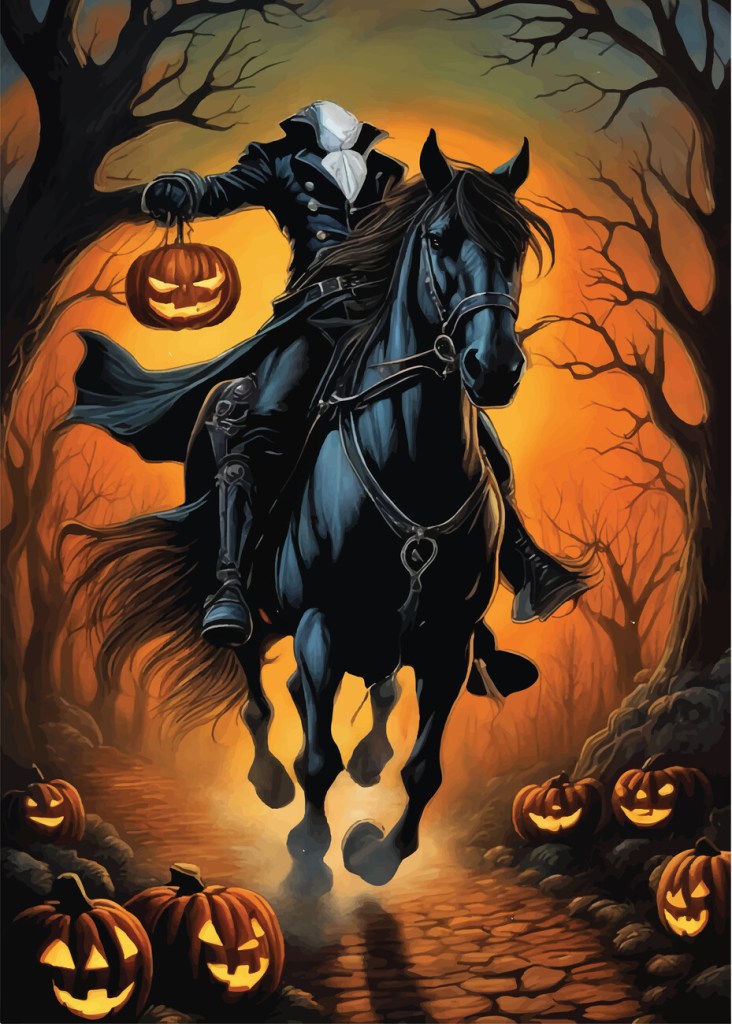
It was at this party that Brom Bones tells the story of the Headless Horseman, the ghost of a Hessian (German soldiers hired by the British to help fight the Revolutionary War), who had been decapitated by a canonball, and who was buried in the Sleepy Hollow churchyard. Every night, he rises from the grave to search for his head, but is unable to cross an old wooden bridge, because you know, running water, etc.

At the party, Ichabod makes his intentions known to Katrina, who rejects him, because obviously lol. He borrows a Van Tassel horse, Gunpowder, the decomissioned plow horse, and sets off home. Riding past the churchyard, he hears hoofbeats and turns to find a cloaked rider behind him. The rider gives chase, but Ichabod makes it to the wooden bridge just as the Horseman throws his head at him.

The next morning, they find old Gunpowder chill as anything, grazing in front of the Van Tassel house. No sign is ever found of Ichabod Crane, save for his hat, which was found beside the shattered remains of a pumpkin, beside the old bridge. Katrina marries Brom Bones, who is assumed to have been the rider in disguise.

Characters

Ichabod Crane, as I mentioned before is a very Scrooge-like character. Obviously, this story is a cautionary tale against gullible people who are also greedy and who kigh key suck as people. In contrast to later portrayals as a misunderstood nerd or dashing hero of the Revolution, the book version of Ichabod is an opportunistic creep. He doesn’t care about his pupls, his eyes are for the mothers who cook for him. Also, let’s not forget that Katrina was his student- which is an unhealthy relationship to begin with, but in the 1790s, a girl nearing the end of her schooling would have been in her mid-to-late teens. That’s not unusual for the time, but it is still gross.

No sympathy for Ichabod Crane.

Brom Bones, on the other hand, is often portrayed as a bully, and…I don’t see why. He’s a prankster, sure, but he’s a teenage boy. Also, it is implied that he is roughly Katrina’s age, and there is a never any mention that he is interested in her money. It doesn’t mean that he isn’t of course, but his motives seem to be personal. Because, remember, Brom was invited to the same parties Ichabod was, he was part of the community. Imagine you’re a seventeen-year-old boy, say, and this much older weirdo comes into town, lusting after this girl you grew up with, and not even for her personally, but for her money, and pretty blatantly at that. I think chasing the old lech and throwing a pumpkin at him, on the scale of things that qualify as bullying, isn’t really that bad. And in the end, he married Katrina, which means Baltus must have approved of him.

Justice for Brom Bones.

Katrina, the…heroine? Love interest? Katrina doesn’t really do much, to be honest. She seems to be a competent student, and she definitely has enough spine to turn down a gross proposal, so that’s good. Of course, we only see her through Ichabod’s eyes, and what he sees is a rich girl who isn’t bad to look at. I wonder what we’d see from Brom’s perspective. Maybe I should write that story.

Better yet, what would we see from HER perspective?

Why I love it so goddamn much

This is on my bed, right now.

Now, I know you’re thinking, ‘Avon, this short story is over 200 years old- I know you didn’t just discover it.’ And no, of course not. In fact, it has been a very special story to me for a long time. I read it every October, as a ritual to get myself into the spooky spirit, and I am often so re-inspired by it that I ask my mother to cook me something Dutch and/or colonial for my birthday (October 23).

In fact, I was in this inspiration soup when I joined Scribophile, an online community of writers, back in the fall of 2014. I took the name Avon Van Hassel. I wanted to pay homage to Katrina Van Tassel, but not take her name, and I found the equally Dutch name, Van Hassel, related to the Lower Saxony (I have some ancestry from the area of the Dutch/German border region) town, Hassel, which in turn, gets its name from a hazel tree. Hazel trees have the distinction in Celtic mythology for imparting wisdom, most notably to the Salmon of Wisdom. There are also a couple of Grimms tales that involve a hazel tree.

Avon is the anglicised form of afon, the Welsh word for river. I’ve always thought it would make a lovely name, especially since some of my favourite cities in England are found along the Avon River. Yes, the River Avon means the River River. And just to clear it up, yes, I know that Stratford-Upon-Avon and Bath are on different Avons. Such is the nature of loanwords. They’re all good. All Avons are the goodest Avons.

Anyway, on Scribophile, you can’t change your name once you’ve committed. The idea is to build brand recognition connected to your name. Well, I workshopped Magic Beans on Scrib, so when I published, I did so with my usename, so my fellow Candied Sea Urchins could find me. And here we are today.

~~~

So yeah, if you haven’t read The Legend of Sleepy Hollow, I recommend giving it a read or a listen. It’s pretty short, so you can knock it out in an afternoon and set yourself up for the seaon. But I do suggest you have a plate of treats nearby, it’s going to make you hungry.

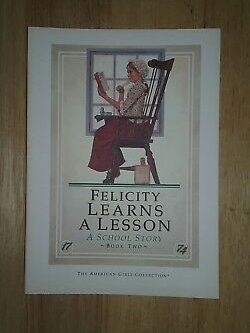
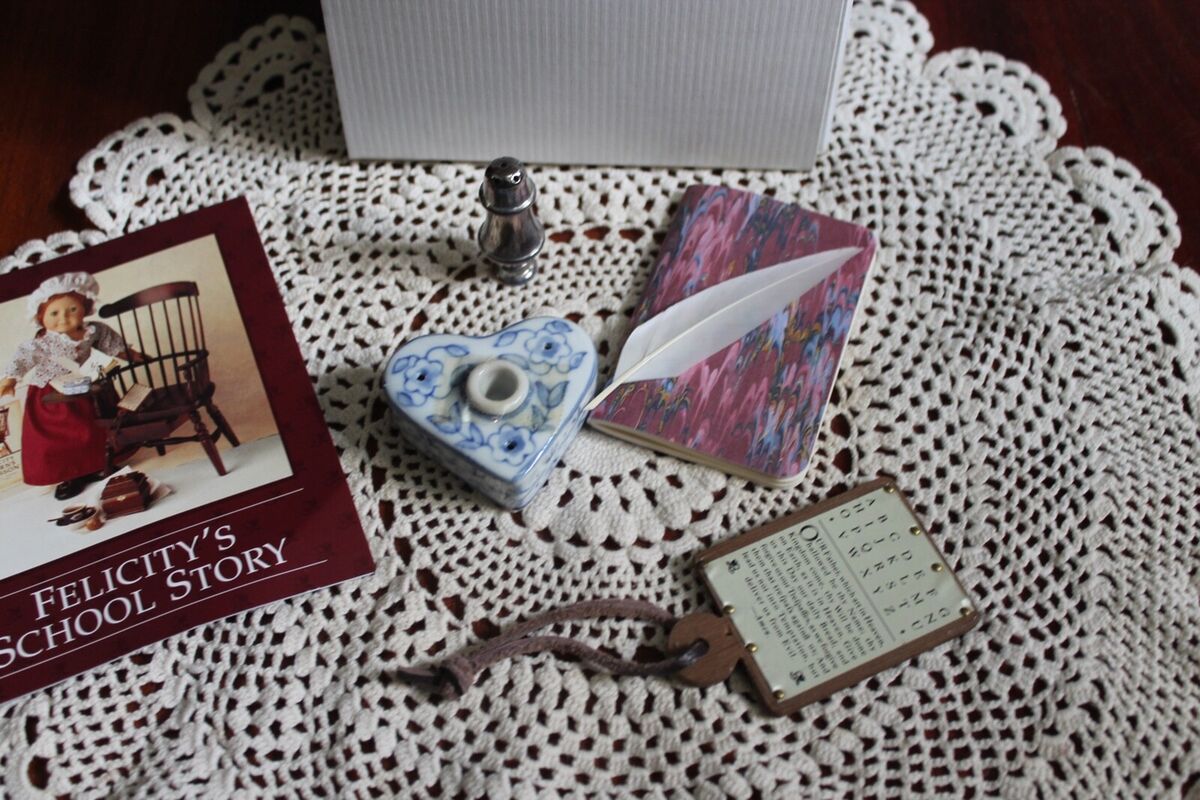
This is a post straight from the brain archives of Baby Avon. When I was a little kid, I was OBSESSED with the American Girl books, and my second favourite was Felicity Merriman (my first was Samantha Parkington, obviously). If you’re not familiar, the original books were in six-part series, each focusing on a different aspect of a historical girl’s life, and each including a non-fiction afterword discussing real aspects of life, like technology and artefacts, little rhymes, important historical figures, and tradtions. The second book was usually [Girl] Learns A Lesson, which showed how education worked in that particular time period, as well as a life lesson the girl would take on, personally. Felicity (1774) went to ettiquette school, where she learned how to politely decline tea without ruining friendships, and navigate the delicate socio-political landscape in the days leading up to the American Revolution. In the afterword, we were introduced to how boys and girls were educated differently, and what sorts of things they learned. One thing that stuck with me was the hornbook.

~This post contains affiliate links. If you’re interested in any of these items, please consider purchasing through the link provided. It gives me a little bit of Jeff Bezos’ filthy, filthy lucre because writing full time is expensive, and he doesn’t need the money for more joyrides in space. 🙂 ~

Like we discussed in the post about coffeehouses, this was the Age of the Enlightenment. And what’s fun is that that extended to children, too! The education of chldren has always been important for as long as people have had children- setting up the new generation is so universal as to be probably instinctual. Now, what that looks like differs across eras and cultures, so we’re going to just focus on the Enlightenment.

We all know the printing press was underway by Johannes Gutenberg in 1440, but contrary to popular belief, that did not necessarily herald a boom in widespread literacy like conventional wisdom postulates. The existence of printed media does make dissemination faster and easier, but it does not correlate to a universally literate population. Hell, media is more widespread now than at any point in human history, and the illiteracy rate in the United States is 21%, as of 2022. So obviously, literacy, defined as the ability to read short texts and understand written sentences, is an important skill, and one that has the capacity to grant access to better opportunities. This was just as important in the 1700s, and began much the same way it does today: learning to recognise the shapes of letters.

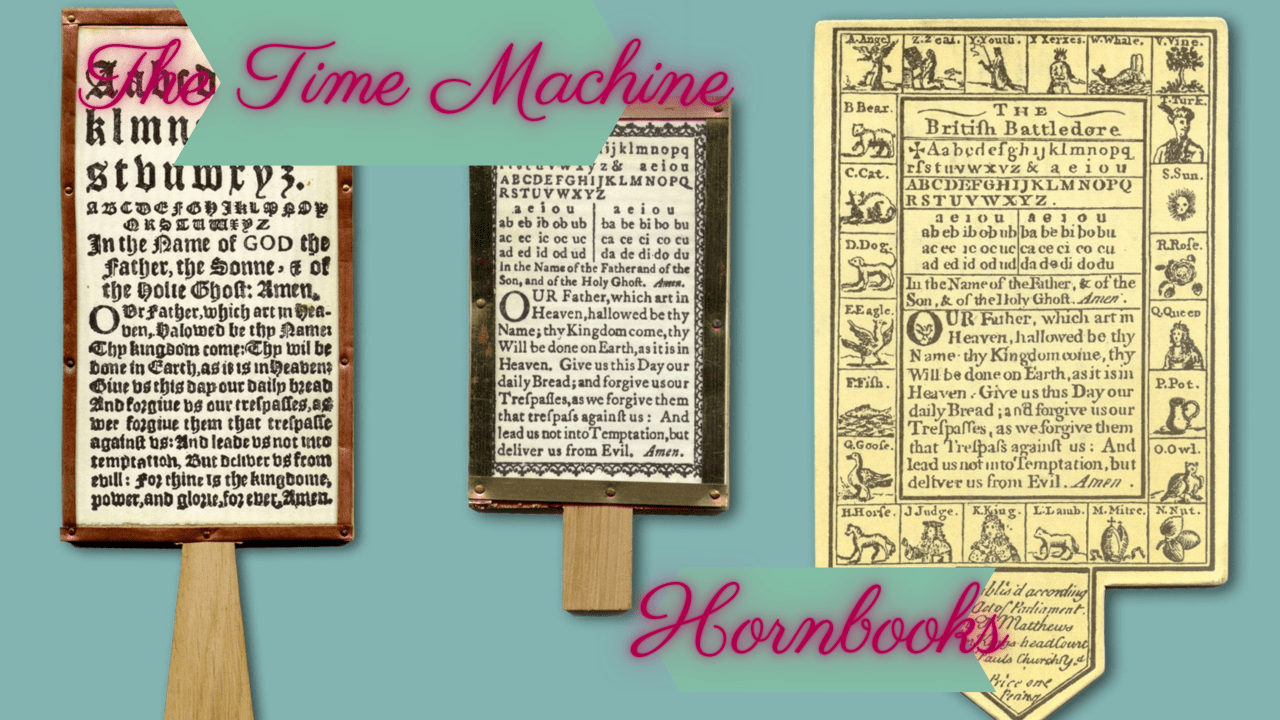
At its heart, a hornbook is a handheld tablet of wood or metal, with a sheet of paper or vellum with the printed alphabet, numbers, sometimes basic letter combinations, and short verses like the Lord’s Prayer, as an example of how the letters are combined to make words and phrases. These little primers are called abecedaria, which is a word I just now learned, and I’m obsessed with it. On top of this is a thin layer of mica or horn, hence the name, to protect it. It looks like a hand mirror, but with letters printed on it. Sometimes the handle had a hole in it so that the hornbook could be hung from a cord around the child’s waist so they could practice on the go.

I completely forgot they sold her school supplies, back in the day

They were called hornbooks, but they weren’t really books the way we think of books. they were not bundles of pages, but just the one sheet protected by the horn or mica. You might think that’s pretty limiting, but remember how complex language, especially written language, is. It takes a little while of repitition and memorization to get it. So, they would start with recognising the basic shapes of block printing, then learn the lower case shapes, then numbers, then how they all fit together, then they get to play with how words are made, and how they carry meaning. They would also usually have a tutor or governess who would guide them through how to use the hornbook, and as they progress into learning to write and imitate the shapes in their own hand, and how handwriting differs from print. It looks simple, but it’s actually a complicated little bit of tech that played a huge role in the literacy of a generation that had a lot to say.

Abecedaria are ANCIENT tools that lasted well into the 18th century, so by the time we got to this era, they were already on their way out, yielding to the advent of dedicated children’ literature. I’m playing with a Northanger Abbey sequel that includes an exploration of real-world children’s lit. In fact, the hornbook faded out so slowly that by the time 19th century antiquarians started selling them as antique collectibles, they were shocked by the scarcity. Most of them had been destroyed or misplaced over the years, just over the natural course of time, as things intended for children often were. It wasn’t until like the 1930s that childhood was seen as an important phase in human development. Childhood items were often handed down, repurposed, or simply thrown away when they were no longer needed, people weren’t as sentimental back then as we are now. Case in point, me still yapping nearly 30 years later about a thing I learned in a storybook related to a doll I wanted.

Full circle.

Explain it to me like I’m a gun-shy pacifist barefoot hippie leftist from Southern California.

-Me on Scribophile, asking for advice on writing guns

***Full disclosure*** This is a very short, very shallow general overview. I am not an expert on guns, I only know enough to write them into my stories, which are set in the 1790s-1810s. This post is intended to answer basic questions for the curious, not to serve as an extensive primer on how to find and use them.

The Journey to Europe

The earliest firearms, called fire lances, where developed in China in the 10th century. They were essentially bamboo or paper tubes filled with gunpowder, and would be affixed to the ends of spears, to shoot fire at the enemy. The tubes would be made into metal, with small projectiles added, and eventually developed into the hand canon in the 13th century.

By the 15th century, the firearm had spread throughout Asia and made its way to Europe in the form of the arquebus, which is immediately recogniseable as a gun. It has a shoulder stock, long metal barrel, priming pan, and matchlock (an ignition system using a long lit fuse used to light the powder)- and was crucially the first firearm to come equipped with a trigger mechanism.

Muskets

From the arquebus, we get the musket. The musket has a long and proud history in Western history. The word, musket, could come from from the French word for sparrowhawk, the Italian word for fly, or the French or Italian word for a crossbow bolt. Something small, fast, and often lethal.

The way a musket was loaded was to pour a little black powder into the pan (and cover with the frizzen to keep it in place) and the rest down the muzzle (either from a pouch or a pre-measured paper cartridge), followed by the wadding (either the paper from the cartridge or a piece of fabric rag), and ending with the lead or iron ball. The ramrod is pulled out from its place under the barrel and used to stuff everything in tight, then returned. To prime, you pull the hammer back to half-cock, or one click, and close the lid of the priming pan. To fire, you pull the hammer back one more click to full-cock, put the butt to the hollow of your shoulder, aim, and squeeze the trigger.

The musket uses a flintlock ignition system, where a piece of flint in the hammer strikes the frizzen, creating a spark, which falls on the powder in the priming pan.

A bayonet, basically a knife on a ring, could be added to the barrel to turn the gun into a spear, ideal for charging the enemy.

Compared to bows, the preferred weapon of Europe from prehistory even into the 1600s, muskets fired much slower. An archer could fire six arrows in the time it took a musketeer to load and fire one shot (musketeers could fire 4 shots a minute), though obviously musket balls did much more damage. If they hit, of course. Muskets were notoriously inacurate, especially at greater distances, and tended to backfire and injure the wielder.

Rifles

To combat (lol) these concerns, innovations were made to the barrel. It’s interesting to note how early these innovations were made, potentially inspired by archery, actually. Pretty early on, fletchers noticed how much more accurate their arrows were when they added a bit of spin to the feathers on the fletching.

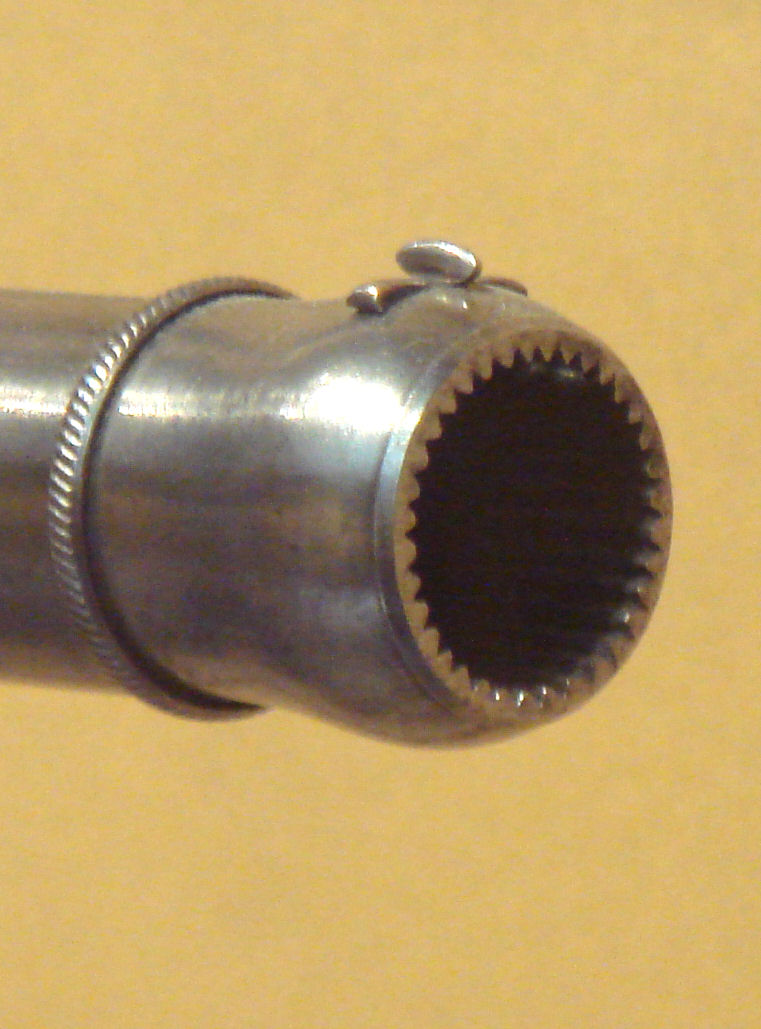
Part of the issue with muskets is that the ball sits pretty loose in the smoothbore barrel (if you point the muzzle down, the ball can fall right out, lol), so when the gasses expand from the lit powder, the ball can bounce along the length of the barrel, which eats up a lot of energy, costing a lot of distance and making the accuracy a little unpredictable. The twisting grooves inside the barrel, the rifling, makes for a tighter fit, and as the gasses expand, they heat up the ball, which deforms to fill the grooves, then as it is pushed out, it spins in the grooves. That spin gives it greater distance and accuracy.

So, why didn’t everyone switch over to rifles? Well, that added little bit of innovation required a lot of extra time and skill, which made them a lot more expensive to buy, both personally and to outfit an army. They also took a lot longer to load. Typically, you could load and fire a rifle twice in a minute, with three being possible if the rifleman was really quick.

So, that math is 2 (and a half, let’s say) shots per minute for a rifle, 4 per minute for a musket, and 24 arrows per minute for a skilled archer. Now, the accuracy: muskets have up to a 48% accuracy at 200 yards, and 18% at 300. That’s a sharp dip. Rifles have 58% at 300 yards and 42% at 500. I don’t have the numbers for archery because there are SO many factors, like wind, altitude, draw weight, skill of the archer, etc. But it also needs to be noted that ammunition has an effect- musket balls can be made in the field by melting lead and pouring them into moulds, whereas arrows take a lot of time and skill to make something that will fly straight. So, yeah, the popularity of the rifle makes sense.

Now, there are no rifles in my books, yet. Like I said, I had to include rifles in the post becase it’s hard to talk about muskets without also discussing rifles. However, neither of my characters would be able to afford to buy a rifle, and by the time they can, they don’t have the immediate need for one. Alois was part of an elite regiment during the war, but the way weapon innovaton happened in the history of my books, the ironmongers favoured power and speed over accuracy, which I will go into a bit more later.

Blunderbusses

The blunderbuss is not a progression of the musket-rifle, but more a cousin of the arquebus, the shorter, stockier, louder descendant of the hand canon, and the ancestor of the shotgun.

The word comes from Dutch, meaning THUNDER BOX, which is charming; mixed with ‘blunder’, meaning to confuse, which seems to be a reference to how goddamn loud and disorienting it is. Sulat carries one, and she is not a subtle lady.

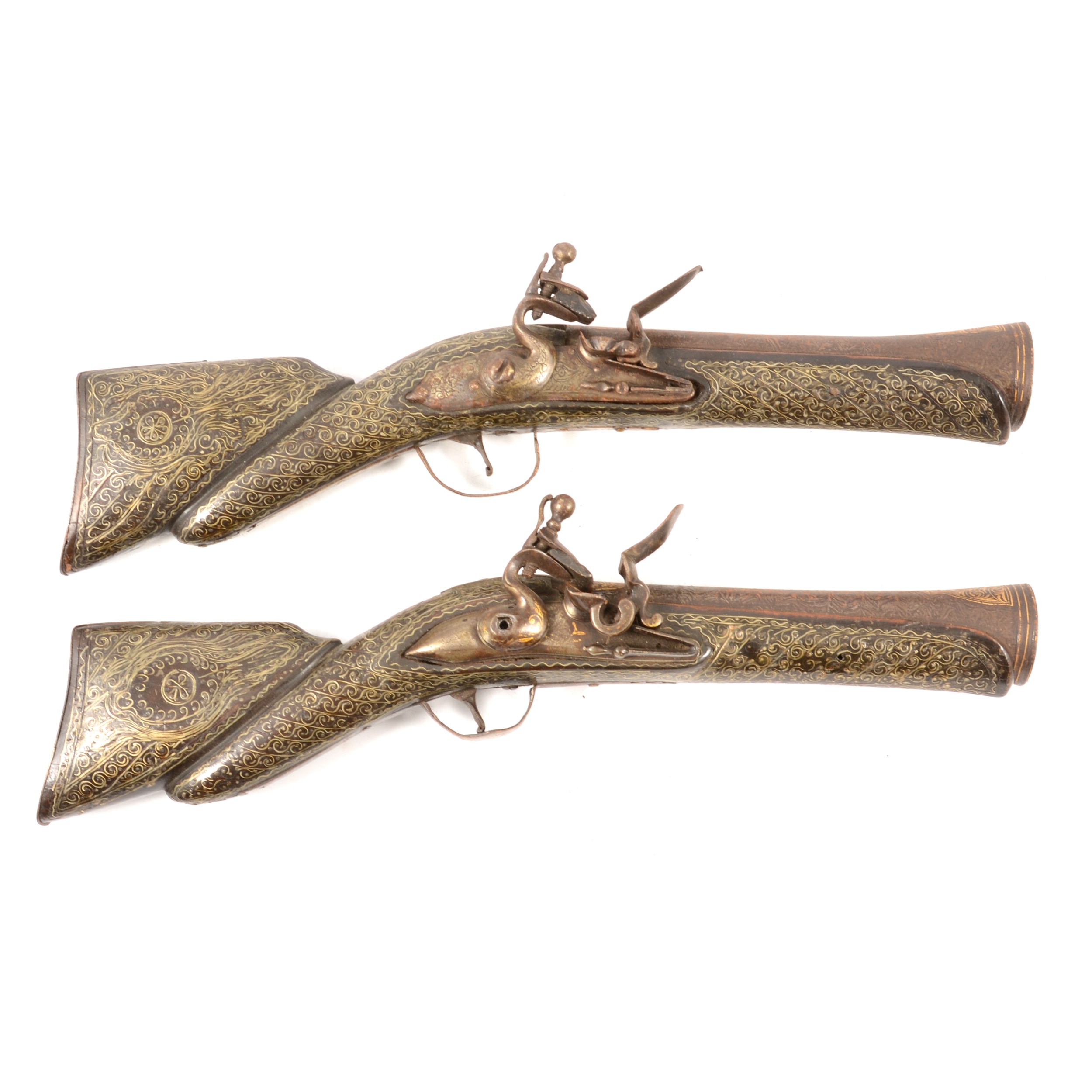
The blunderbuss has a short barrel with a flared muzzle, designed to fire shot (pellets) or other large projectiles. Basically, you can load it with anything, from a handful or gravel to a musket ball. It is also a flintlock, with a load of brass hardware, in addition to the ironwork

Bonus: Alois’ Dragon Pistols and the Ettin Gun

Ok, so those are the recogniseable guns that you’ll see in my books. But there are two more types that are mentioned frequently: Alois’ pair of dragons and his Ettin Gun.

A dragon or dragoon was also a real gun, basically a pistol version of the blunderbuss. It was much shorter, and still designed for shot and still very loud. It was called a dragon because of how intimidating that report was, but also because they tended to be carved with dragons along the brass barrel, which is kinda cute. Alois carries a pair of them. He is a better swordsman than Sulat, but a worse shot; she is a better shot, but her slight build means she prefers to fight from a distance.

~~

The Ettin Gun is my own invention. It is a combination between an elephant gun and a 4-barrel pistol, which are both real guns. Multiple-barrel guns, like the rotating pepper-box, are nothing new. They allow multiple barrels to be loaded at one time, though the single flintlock mechanism requires that each be primed individually. Still, it cuts back on load time significantly.

The elephant gun was developed much later, as Europeans stormed into Africa for the purpose of big game hunting. My military engineers had to speed up the timeline a bit to deal with the invasion of two-headed giants onto their own lands.

The combination created a giant 4-barrelled musket that required extensive training, a tonne of equipment, and a weilder with enough shoulder meat to handle that kind of kickback in rapid succession. Alois still has his Ettin gun, but its inherent value and scarcity since the end of the war makes it something of a theft liability, so he keeps it hidden away.

~~~~

So, there you have it, a brief toe-dip into the world of popular flintlock guns. I have seen some fun novelty ones, like a rifle with a heart-shaped muzzle. What other interesting weapons would you like to see me explore?

Writing is hard.

It’s not laying bricks or open-heart surgery, but it is definitely challenging.  It’s made doubly challenging when you’re trying to make a regular habit of it. The conventional wisdom is that you have to exercise it like a muscle, right? Do it consistently,  and eventually, it gets easier. But getting through the mushy middle to the point of consistency can be tricky.

For times like these, I invoke the humble Inspiration Board.

What is an Inspiration Board?

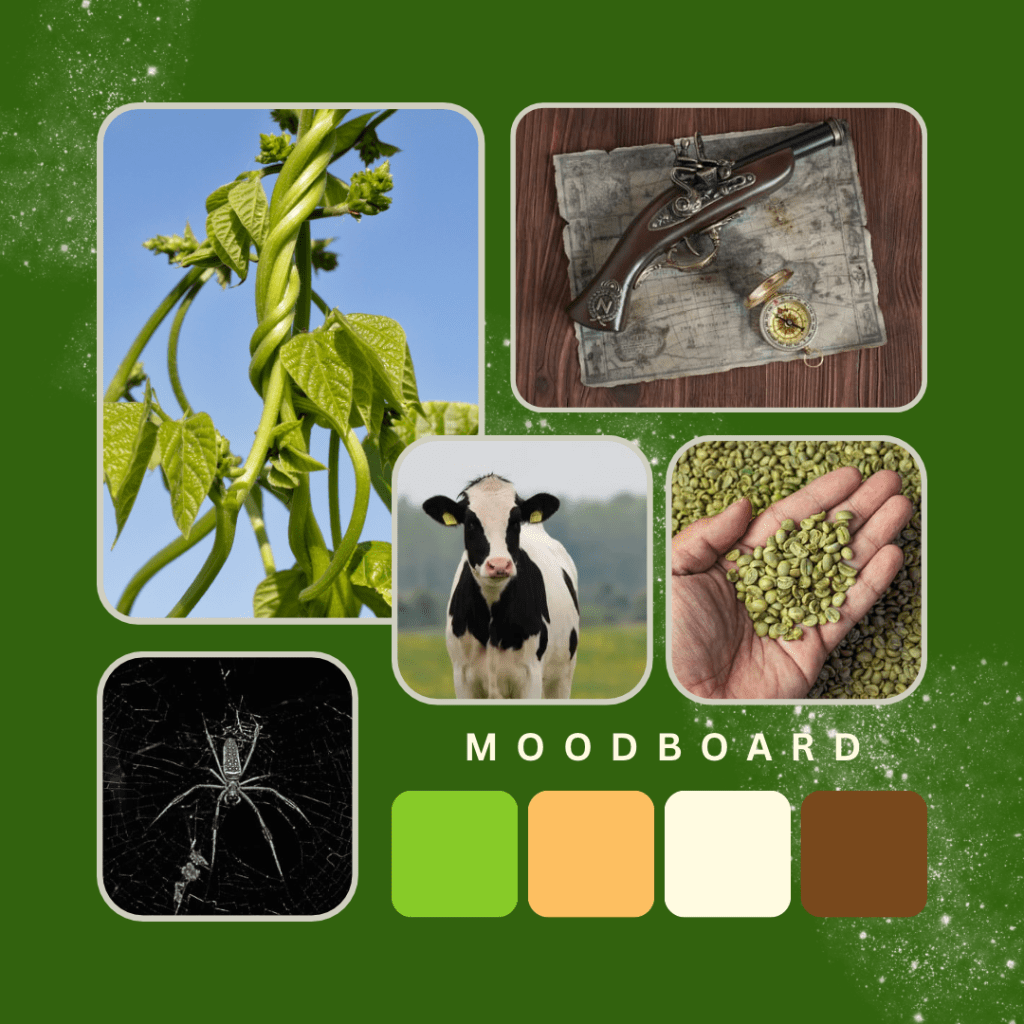
At its most basic level, and inspiration board is a visual representation of your story. A lot of times, the germ of a story comes from a vibe or a line from a song or an image- one tiny speck of nothing that blooms in your mind into an idea you can’t let go. The inspiration board seeks to capture that, so you can access it whenever the excitement starts to wane. It’s how you rekindle that initial spark.

It can also help play with new ideas- things you want to try, ideas you don’t have a place for yet but that you don’t want to forget, other vibes or images that tickle the same place in your brain as the originals. 

What goes on an Inspo Board?

So, I do have a template I use for my normal Inspo boards,  and I will post it here for you.

A quick one I whipped up for Magic Beans

However, there are a number of different styles of boards. Mood boards, inspo boards, 5 year plans, dream boards, vision boards, motivation boards. There is obviously a lot of overlap between the different types, so knowing which kind you need is important.

This might sound like a bit of a departure,  but stay with me: why do you want to write? And follow up: what do you want to write? Finding your why and your what will help you with your how.

Writing for yourself and writing for a career are totally different beasts. If you’re writing for a more informal context, you can base your board around vibes. Focus on colours and textures and tone. If you’re hoping to publish, you have to be quite a bit more detailed and specific.

Where to Find Your Images

Again, this depends on your needs. If it’s just for you, Google Images is great. If you’re hoping to show it to the public, be aware of the ethics of sharing images and get familiar with copyright laws.

The best source is hand drawn art, either by yourself or another human. I am 100% of the stance that AI art is theft. Just to get that out of the way.

If you’re not a good enough artist for your needs and can’t afford to pay someone, don’t discount stock photo archives. Here is a list of great image sources. And there’s nothing wrong with using an image with a watermark. It doesn’t look as nice, but it’s a way to get a perfect image for free.

Ok, Now You Have Your Board, How Do You Use It?

There are a few uses for these boards.  The main one is to inspire you, to keep your excitement high, to keep your mind sharp.

You can also use it to introduce your work. You can send it to your betas to make sure your finished wip matches the vibe you were going for.

You can also use it for marketing. You have a built-in brand package, from colours to symbols, from original or stock art to mood. You might have already included comparisons to other similar works.  You can use it as a launching point for an ad campaign or cover design, you can even share it around in its raw form to drum up interest.

~~~~

So why are you interested in Inspo boards? What sort of things will you be sticking on yours?

If you’re here on my blog, you probably love a coffee shop. (If you’re a tea-only person and prefer the tea house, I have a post for you, too)

How many of you have pitched a laptop or tablet at a rickety table with a hard wooden chair, listened idly to the hum of chatter, the clinking of ceramic, and the growl of the milk steamer? Bang, bang, bang, goes the barista, before locking fresh espresso back into the machine. They call your name and you grab your hot black essence or blended tan cloud and cling to it like it’s the actual nectar of the creativity gods, infused with inspiration and focus. The warm, toasty aroma surrounds you, the noises fade into the corners of your awareness, and you just know you’re going to get So Much writing done.

Or maybe you’re there to meet a friend. You chat about anything and everything, while the world, including the drink you went there for, falls away. It’s a vehicle, really, an excuse to spend time together and get caught up on the news of the day, as much a setting detail and prop as the chalkboard displaying the day’s special and some witty pun.

A lot of you probably remember the Starbucks boom in the late 90s-early 2000s. It seemed like overnight, there were diners where you could get coffee and then suddenly, there were Seattle-based megachains and drive-thrus everywhere. Well, Starbucks did not invent the coffee shop craze. 200 years earlier, they were all the rage.

~This post contains affiliate links. If you’re interested in any of these items, please consider purchasing through the link provided. It gives me a little bit of Jeff Bezos’ filthy, filthy lucre because writing full time is expensive, and he doesn’t need the money for more joyrides in space. 🙂 ~

An authentic coffee cup from the 1790s, my friend generously allowed me to use in my YouTube video!

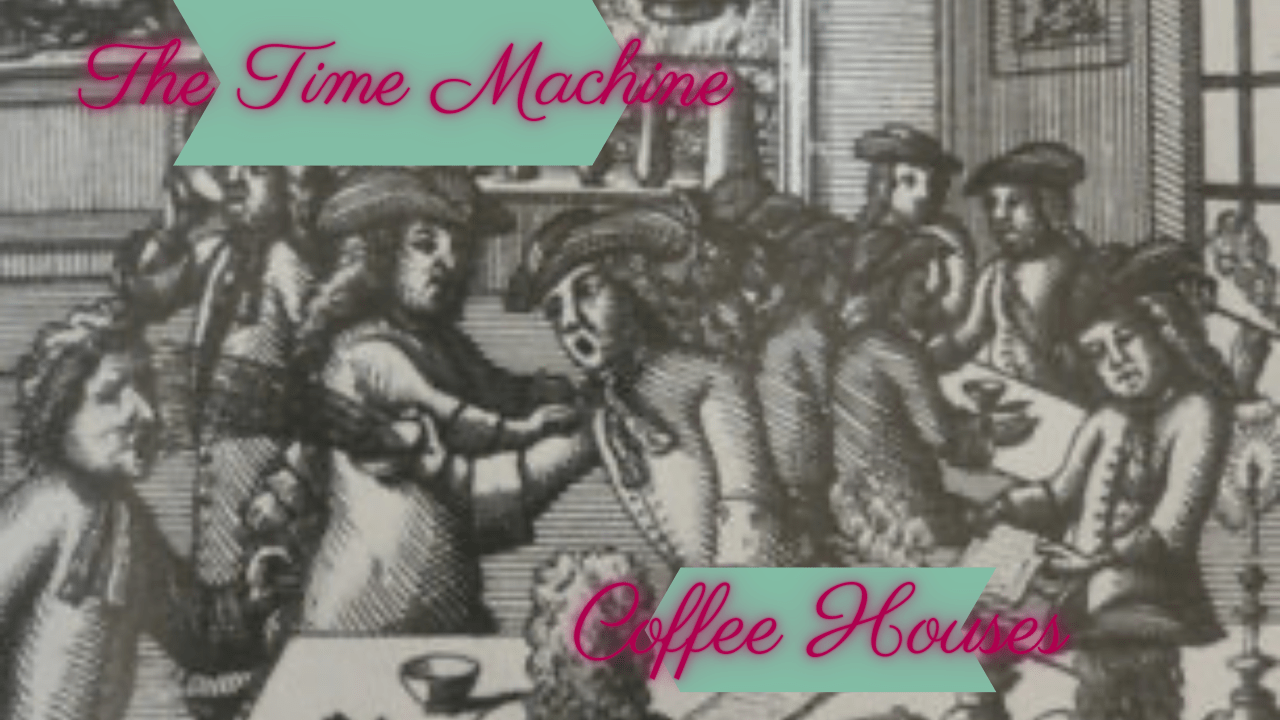
Coffeehouses in the Georgian era looked a lot like how we expect them to: comfortable furniture, bookshelves, tasteful decorations. And part of that is because of branding. Coffee was perceived as the anti-alcohol. It stimulated rather than dulled, invigorated rather that sedated, it encouraged calm intellectual discourse rather than feuling baser passions. No one ever started a brawl because they had too much espresso. At least, that was the perception, as we’ll get to, in a moment.

You see, this was the Englightenment, a period of time when Europe was spending a lot of time thinking. They were debating the nature of Man, of government and kings, of God, of the structire of society, of the past and present and future, or money, of art, of the science of the earth and the stars. They were thinking about thinking. And they were gathering to talk about what they were thinking about. Coffee culture was caused by the Enlightenment, and it fuelled it. People (men) from all walks of life gathered in these comfy, well-outfitted coffee houses, and discussed the matters of the day.

So what did they actually serve?

Coffee at a coffee house was more like diner coffee then, than what we think of today. It wasnt thick foamy espresso or a blended drink that, let’s face it, is a coffee flavoured milkshake. It did often have milk and sugar, and just a little fish bladder.

Well, fish bladder or skin; egg whites or shell. Let me explain. The recipe, pasted below, from Maria Eliza Kettleby Rundell’s 1808 cookbook, New System of Domestic Cookery, calls for the boiling of coffee grounds for a total of eleven minutes, with at least ten minutes of steeping time. That makes a muddy coffee. Isinglass is a sort of gelatin-like substance made from the swim bladders of fish like sturgeon. It’s the collagen, present in eggs and actual gelatin, that will soak up those impurities like a magnet and rise to the surface in a kind of foam, which you can skim off. This creates a wonderful clarity and gives it a bit of a smoother mouthfeel, that some might find negates the need for cream and sugar at all.

For those of you struggling to see the image, here is the text:

Put two ounces of fresh-ground coffee, of the best quality, into a coffee-pot, and pour eight coffee-cups of boiling water on it; let it boil six minutes; pour out a cupful two or three times, and return it again; then put in two or three isinglass-chips into it, and pour one large spoonful of boiling water on it; boil it five minutes more, and set the pot by the fire to keep it hot for ten minutes, and you will have coffee of a beautiful clearness.

Fine cream should always be served with coffee, and either sugar-candy or fine sugar.

If for foreigners, or those who like it extremely strong, make only eight dishes from three ounces. If not fresh roasted, lay it before a fire until perfectly hot and dry; or you may put the smallest bit of fresh butter into a preserving-pan of a small size; and when hot, throw the coffee in it, and toss it about until it be freshened, letting it be cold before ground.

Now, if you’re more of a visual person, fear not! I made a video, showing you how to do it!

Coffeehouses were often called penny universities, or universites in a cup (one article on the subject called them the internet in a cup, which I don’t disagree with), because for the price of a penny at the door, you could get a cup of coffee, all the extras like milk and cream, and any other services the house provided. For a penny, you had access to whatever conversations were going on. People from all walks of liife could mingle and get different perspectives, they could hear the news of the day (newspapers were performed out loud), they could interact directly with politicians, clergy, gentry, the business owners, ‘the middling sort’ (middle class people), writers and artists, foreigners, day labourers, and even criminals. Some people spent so much time at coffee houses that they listed the house as their mailing address!

Now, of course, it wasn’t just coffee sold here. There was a healthy dose of elitism about coffee house being temples of rationalism vs taverns and alehouses etc as dens of sin, but the line between them was a lot more blurry. People are going to make money however they can, and if the intellectuals want beer and gin, they’re going to get it.

One notorious coffeehouse went a step further. King’s Coffee House, run by Tom and Moll King, and known colloquially as King’s College, served as a sort of brothel-adjacent venue. They couldn’t host sex workers because that was illegal, and in fact the only bed on the premises’ was the Kings’ own, but they did host sort of meet-cutes for sex workers to meet with potential clients and take them elsewhere to perform their services.

So I mentioned earlier how The Enlightenment and coffee culture influenced each other, and now that you’ve seen how people came together over a hot cup of Joe, with even the consideration of foreign tastes written into the official recipe, it’s not hard to see how the inevitable outcome was rapid and vigourous social change. When people from different backgrounds, with different experiences and obstacles, come together and talk, it’s difficult not to be affected.

This was a classic example of a third space, a place for people to go other than work and home. At the affordable price of a penny, a man could gain access to news and ideas, and make his own voice heard, which was a level of social fluidity rarely seen before.

Now, of course, this is a very shallow understanding of the coffeehouse and the impact on society and history. If you would like a deeper dive into the rise and fall, the role of women, and other social criticisms, do let me know. I actually would love to look closer, as well as at the real meat and potatoes of the tea trade. Let me know!

In the meantime, check out my video on YouTube!

The Muses

So, every so often (usually when Facebook won’t let me share posts to my author page), I poll the Misfits about the kind of posts they’d like to see me write about. One of the most popular ideas was mythology related to gods and spirits ruling over the domain of creativity. So, who better to start with than the actual Muses?

*sigh* Full disclosure, I’m not an ancient historian or a classicist. Yes, I have a degree in archaeology; yes, I’m a big nerd whose favourite hobby is research; and yes, I am a pagan who kinda-sorta works with one of the Muses. None of that makes me an expert in Greek mythology or history. There is so much, you guys. The problem with ancient stories and religion is that their history is long, complicated, and shifts wildly over time and region.

Just thinking about someday having to talk about Thoth (or, really, any Egyptian) makes my chest feel tight and my eyes moist. I mean, I’ll do it, but the dread is real.

So, with that in mind, let’s lower the expectations, and move forward.

The Muses, like a lot of figures in Greek mythology, likely predate Greek culture, and might come from the Thracian Empire, which recognised 3 Muse-like figures. It seems like we decided ultimately on 9, mostly because famous poets like Homer said there were 9.

So, with all of that out of the way, let’s carry on. When last we spoke of the Muses, I touched a bit on the history of how The Muses came to be, what they collectively represent, how to approach them. I also touched a little on Calliope, Queen of the Muses, and my personal muse. This year, I’m going to introduce Klio and Euterpe.

~This post contains affiliate links. If you’re interested in any of these items, please consider purchasing through the link provided. It gives me a little bit of Jeff Bezos’ filthy, filthy lucre because writing full time is expensive, and he doesn’t need the money for more joyrides in space. 🙂 ~

Klio

‘Kleio’ with a K means, ‘to exalt’ or ‘to celebrate.’ The spellings are interchangeable, but the K is thought to be more accurate to her original name.

With her parchment scrolls, open books, tablets, and trumpets, she is called, ‘the Proclaimer,’ and her symbols also include water clocks and laurels.

This glory and time association makes her the muse of history. She is the muse who tells the great true stories of war, love, and cleverness.

One funny story is that she mocked Aphrodite for falling in love with Adonis because Aphrodite is a mess. So in revenge, Aphrodite cursed her to fall in love with Pireus, son of King Magnus,  with whom she had a son, Hyacinth. Hyacinth was famously a lover of the god, Apollo (who is sometimes romantically involved with all 9 Muses, yikes), as well as the West Wind, the North Wind, and a mortal Spartan singer.

So like, yeah your boyfriend may be a pretty boy, but my son is THE pretty boy. Bit of an own goal, there.

How to invoke

Set laurels on your altar, wear laurels in your hair or on your head. Proudly proclaim your accomplishments, past and present.

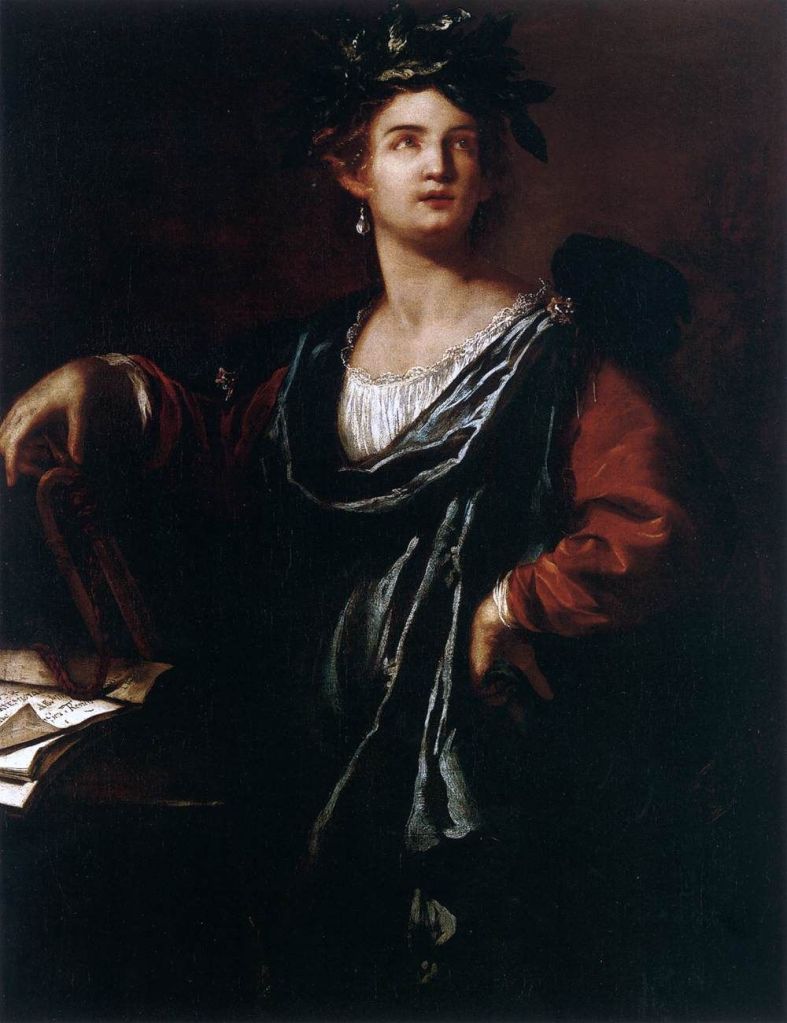
Clio by one of my faves, Artemisia Gentileschi

Euterpe

Euterpe’s name means, ‘bringer of delight’ or ‘rejoicing well.’ She is generally regarded of the myse of music and lyric poetry.

Lyric poetry, for those who have heard the term over and over, but never an actual explanation for what it is, is a type of poetry, usually accomplished by music, that explores emotion and feelings in the first person. Very recogniseable, even today, as most of the songs you like. That’s Euterpe.

She is also thought to be the inventer of the aulos, or the double flute, as well as other wind instruments. For this reason, she is the muse of musicians and performers.

Euterpe by Jean-Baptiste Auguste Clésinger, on the grave of pianist, Frédéric Chopin

How to invoke

Play music, especially music you wrote. Pray to her before writing new music or poetry

~~~~

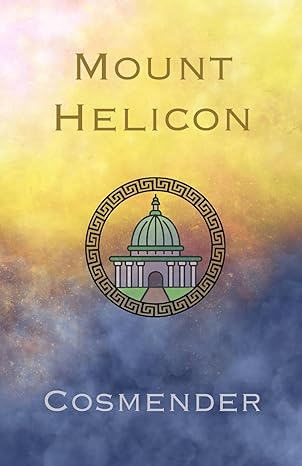
If you love the Muses and want to explore modern Greek myth a little more, have a look at my sister’s book, Mount Helicon.

Every year, I poll the Misfits, and every year they vote ‘time management’ as the topic they most want advice on. I can relate, I also struggle with it. But I do have some tricks, and maybe this one will help you.

Time Blocks

These three techniques are simultaneously totally different, and basically the same. They’re really all about concentrating your focus on one thing at a time.

Time blocks are chunks of time set aside for a task, in this case, writing. Do you have a full time job, or do you have erratic hours? Do you stay at home with young children or other people who need round-the-clock care? Do you have your own health issues that prevent you from sticking to a writing routine? That’s fine! Time blocks could be the answer.

Time blocks allow you to find the times of the day or week where you can dedicate your energy to writing. For me, it’s Monday-Tuesday-Thursday-Friday mornings from 8-noon. My mental power is strongest in the morning, but I burn out after a few hours of rigorous mental work, and I dedicate my afternoons to my house, family, and volunteer work.

Your best times might be after the kids go to bed or are at school, maybe it’s your lunch break, maybe it’s in a different place every day. The important point is recognising where it is in advance so that you can build a ritual around it, rather than trying to seize it when it comes. It’s hard to be creative when you’re hunting for minutes.

So once you identify your time block, how do you defend it? I’m not going to lecture parents about making time for yourself or preach at line cooks about prioritising your creative life. This shit is hard, and sometimes it is the easiest thing to sacrifice in favour of everything else.

But if you are able to get the time and energy together at the same time, sometimes your brain fights you. In these instances, you can yank it back on board by activating a mini ritual. If you’re in a safe but noisy environment, you might try headphones or earplugs. If you’re at home, grab a drink and light a candle. It doesn’t need to be elaborate, it just needs to signal to your brain that, ‘right, we have 30 minutes. Let’s get some words down on paper.’ And remember that what you write doesn’t have to be perfect, but it does have to exist. You can always edit during a time block, so the time will come to make it look nice.

You can also combine time blocks with other techniques like dictation and the Pomodoro Method.

Task Batching

Task batching is all about flow, and it’s one of my faves. Basically, you break down your big tasks into smaller tasks, decide what order they go in, and do all the similar tasks at the same time.

For instance, when I’m planning my blog posts for the year, I break them down like this:

  • Title
  • Outline
  • Draft
  • Edit
  • Design cover images and Instagram posts
  • Add pics
  • Add links
  • Edit again
  • Add tags
  • Schedule
  • Schedule social media posts

So, when I sit down to start my blogs, I open twelve new blog posts and title them. Then I go through each of them, setting up the topics I want to talk about. Next, I take a couple of days to write the actual post themselves (what you’re reading now was written during the Draft batch). Etc, etc.

The downside of this technique is that everything is done all at once, so if you don’t finish all of them, you don’t finish any of them. This is what happened last year. But if you find the cycle of ‘plan, write, edit, publish, plan, write, edit, publish, plan, write, edit, publish’ a little overwhelming, this might be one for you to try.

Micro-scheduling vs Day Theming

Micro-scheduling and Day theming are pretty self-explanatory. Some people benefit from a strict routine, and some need a bit more flexibility.

A micro-scheduled four-hour block might look like:

  • First hour: Pomodoro (25 mins of writing, 10 min break, 25 mins of writing)
  • Second hour: Research and plan for tomorrow’s work
  • Third hour: social media posts
  • Fourth hour: read fiction

This works great if you have a solid four hours with no threat of interruption, even from your own attention span. Or if your the sort of person who really needs strict structure.

Day theming is kind of the reverse, but not really. A four-day work week might look like:

  • Monday: drafting
  • Tuesday: research
  • Thursday: social media posts
  • Friday: read fiction

This works great for people with less reliable time blocks, or who need more flexibility in their structure. Four hours of drafting is four hours of drafting, whether it’s done in the same day or over the course of a week.

~~~~

Check out my YouTube video, here!

~~~~

Do these ideas work for you? Are there any you’re excited to try? What techniques do you use?

Ordinarily, I don’t like to do too many similar posts in a row, and I know I’m posting a biography directly following a double biography, but I have to strike while the iron is hot. I’ve just arrived home from a trip to the UK, where I visited one of his gardens, so it’s relevant. Plus, what better time to talk about gardens than the spring?

Lancelot Brown was born on August 30, 1716, in Kirkharle, Northumberland. His mother, Ursula, worked in service for Sir William Loraine at Kirkharle Hall, where his father, William Brown, was the land agent. After school, Lancelot got a job at Kirkharle, working for the head gardener’s assistant in the kitchen garden. When he was 23, he began moving around the country, working in various gardens until he got his first commission, a new lake in the park at Kiddington Park, Oxfordshire.

In 1741, he went to Stowe Gardens, where he worked under William Kent, probably Britain’s next most famous gardener. He stayed here for nearly ten years, during which time, his employer, Lord Cobham allowed him to take freelance commissions from other landowners, which helped him grown his reputation as a landscape gardener. He was a skilled horseman, and that allowed him to not only travel quickly, but assess the properties quickly. Indeed, he earned his nickname, ‘Capability,’ from his habit of telling people that their land had capability, or potential, for improvement.

In the 1760s he was already known to the Crown, having been appointed by King George III as Master Gardener at Hampton Court Palace, and he was earning enough from commissions to buy an estate off the Earl of Northampton, where he was appointed High Sheriff of Cambridgeshire and Huntingdonshire. Not bad.

On February 6, 1783, he suddenly collapsed on the doorstep of his daughter’s house after a night out, and subsequently passed away. He was buried in the churchyard outside his estate, and left what would be valued at £6m to his family.

Famous gardens

Several of Brown’s gardens survive to this day. You may have heard of some of them

Cardiff

Nearest and dearest to my heart, is the central courtyard of Cardiff Castle. We’re going to cover in a second why I didn’t appreciate it at the time for what it was.

For those of you who don’t know, I am an American, but I went to university in Cardiff. I got my undergrad in Archaeology there, so I was there for three years, and obviously, as a medievalist, I spent a lot of time at the castle. A lot of the recogniseable details of Cardiff Castle are attributed to the Marquis of Butte, who’s aesthetic is on full display in the Tý, or House, the residential part of the Castle, where the Marquis and his family actually lived. However, the most seen and used area, the courtyard and Norman Keep on its lil motte (or small hill inside the castle), are the work of Capability Brown.

Now, as the name implies, the Norman Keep does date back to the Norman Conquest. Brown didn’t build that. But the motte originally had a moat, which he filled in, and he added a spiral path up the motte, which was replaced later by a staircase at the front. You can still see indentations of the spiral path, though. He also removed all of the other small buildings and a full height wall, complete with its own buildings, which had spanned the distance from the gate entrance to the Keep. The foundations of that wall are still there, but it is said that the stones from that wall built many homes in Cardiff after that. The result was a flat, smooth lawn, with the Norman Keep standing proud in the centre.

Style

When I was doing research for this post, I came across the extant garden at Cardiff Castle, and I was very confused. Garden? What garden? I’ve been all over that castle, where is the garden? There are gardens and parks all over Cardiff, but no, they’re talking about the one inside the Castle.

Right there.

That one.

You’re looking at it.

The confusion came from not yet fully understanding the aesthetic of 18th century gardens and Capability Brown’s influence, specifically. I knew he was a big deal, I knew the name, but gardening, to me, was very much hedge mazes and rose bushes, that is the exact opposite of what we’re looking at here.

To understand, we have to look back, back further than the 1760s. That sort of formal, geometrical style of gardening was the norm for most of British history, and it came back after Brown. It takes a lot of upkeep, which requires a gardening staff, which is a form of conspicuous consumption; it often features exotic plants, which shows off wealth; and it takes up massive parcels of land that could be used for crops but instead is used for leisure and beauty. Also pretty plants with pretty smells. You get it.

Enter, the Enlightenment. What is the nature of Man? What is the nature of nature? Is man higher than God?

Also, tension was cooking in Europe, so travel to Europe was awkward. Brown died before the French Revolution and the following Napoleonic Wars, but he would have known about the American Revolution. Change was in the air.

At this time, we had the birth of the staycation, or their version, which was taking sketching holidays to the Lake District. Basically, they were stuck inside the house and were forced to appreciate what they had. Britain learned to fall in love with their own natural beauty. It was a very pariotic time.

Capability Brown was a pioneer in this area. When he said a property had capability, he meant it had natural beauty he could enhance. He loved a flat lawn, or a gently rolling hill, maybe an accent bush, like a beauty mark on the upper lip of a fine lady. Not for him was the hedgerow or orchid house. The idea was a vista, wide open space- a pastoral countryside captured, tamed, and nurtured within the property of a landowner. The simple, unadorned, natural beauty of Britain. Nothing fussy or frilly. Look at the gardens at Versailles- you wouldn’t want anything fake and French like that, would you? Ew.

And people ate it up. It was the minimalism craze in the 1760s. Rich people love conspicuous underconsumption, as well. It’s still a lot of perfectly good land that just…had nothing on it lol, and a massive staff required to keep that lawn looking meticulously unmanicured. It requires the same amount of upkeep, it’s every bit as curated and deliberate as a more traditional looking garden.

But god, they make for some really nice paintings. The picnics you could have on that lawn, can you imagine?

So that wide, smooth, flat lawn with a tidy Keep on a moat-less motte at Cardiff Castle? That IS the garden.

The Regency Redingote

Historical Snippets of Regency England

Raveena at Home

Professional Organiser, Malaysia

Unfuck Your Paganism

We can do better

Jane Austen's World

This Jane Austen blog brings Jane Austen, her novels, and the Regency Period alive through food, dress, social customs, and other 19th C. historical details related to this topic.

Underflow

Prayers to the Gods of Olympus

The Forest Witch

Singer of Spells, Tea Maker, Artist

GLOW RECIPE

Natural Korean beauty, hand-picked with love

Gather Victoria

ANCESTRAL FOOD. HERBAL WISDOM. MAGICAL COOKERY. SEASONAL CELEBRATION.

Colonies, Ships, and Pirates

Concerning History in the Atlantic World, 1680-1740

The Old Shelter

Sarah Zama Historical Fantasy Author and Creative Writing Coach

Whitley Abell

Youth Librarian

Dun Brython

A Brythonic Polytheist Blog

Words That Burn Like Fire

Welcome to the Adventure

The Druids Garden

Spiritual journeys in tending the living earth, permaculture, and nature-inspired arts

Jacob Devlin

Please don't feed the dragon.