
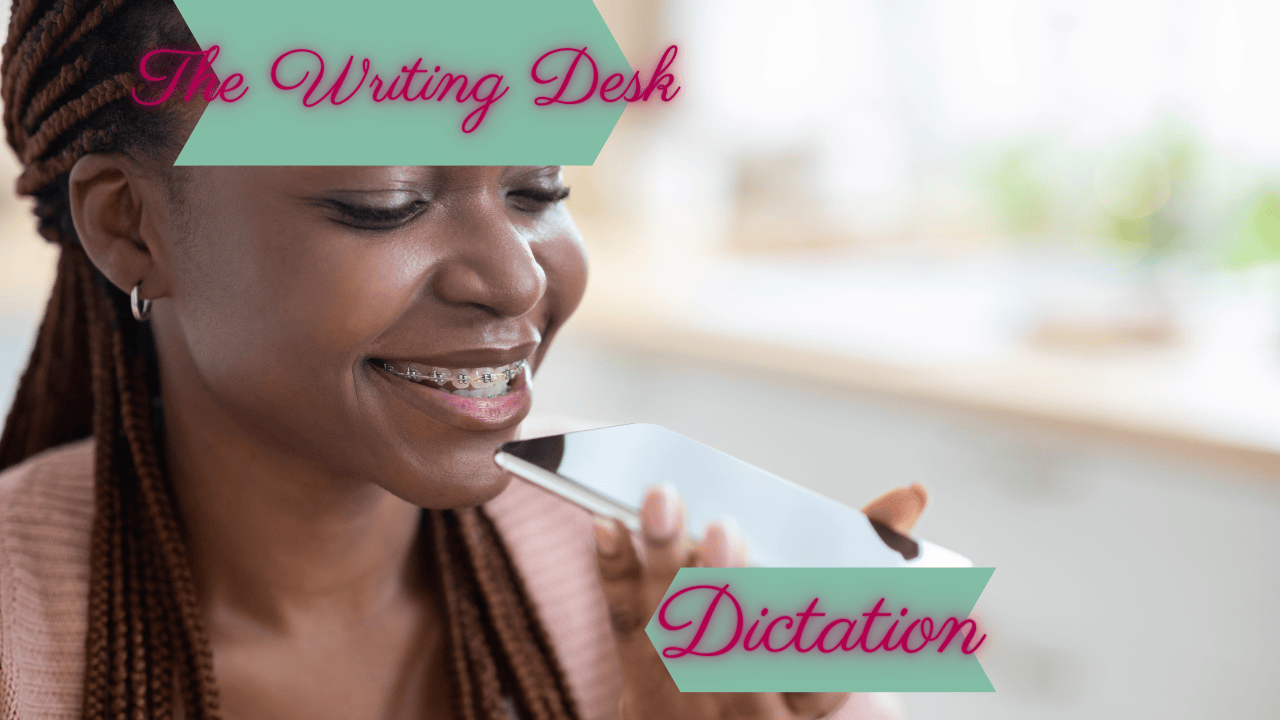
Every year, I poll the Misfits, and every year they vote ‘time management’ as the topic they most want advice on. I can relate, I also struggle with it. But I have one last trick up my sleeve that could help you.
You might recoil at first, but stick with me.
Between you and we, and we’re all friends here- do you ever…talk to yourself? Like, out loud?
Do you ever act out dialogue between your characters, while you’re in the shower, while you’re doing dishes, while you’re daydreaming on your commute to work?
I do. I think most of us do. It’s normal.
Well, this is how you turn that embarrassing little habit that you don’t want to admit into actual productive writing.
Dictation is basically writing a story out loud, verbally. Sometimes you can’t type or write, but you have to get your ideas down. It’s a hands-free method, if you will. Loads of people do it for a variety of reasons from vision impairment to physical disability to multitasking.
The easiest way to do it, for me, is a voice-to-text app. You speak into it, and it translates your voice input into text. You can also simply do an audio recording and transcribe it yourself later, if you are able. Of course, if you are very lucky, you might have another human nearby who is willing to lovingly take down your words of wisdom for you. It worked for Milton.
Advantages/Disadvantages
The main disadvantage to me is in how awkward it can be. I feel like it takes a different part of your brain to tell a story than it does to write. It also doesn’t help that a lot of the voice-to-text apps I have only let you talk for a minute at a time, which is not enough time to get into a flow for me.
And don’t get me started on FFUUCCKKIINNGG AI.
Another disadvantage to me, related to flow, is how awkward it feels. It just feels weird. Telling someone about my day is very different to writing a book, in terms of pacing, setting the scene, dialogue, even word choice; then doing that in an empty room? Weird.
However, if you can get an app that gives you more time, and you can get over (or don’t have) issues with telling yourself your story out loud, this can be a FANTASTIC tool. It saves time, it saves energy, you can do it anywhere, you can talk naturally, it accommodates some disabilities- and best of all, it gives you a real idea of what your writer voice SOUNDS like. A lot of beginning writers, and even more experienced writers, don’t really know what their writer voice sounds like. You know what your oratory voice sounds like, you know what your prose voice looks like, but what does it sound like? It is essential to your brand to know how you sound out loud. Because the voice that you hear in your head is not the way you sound in someonme else’s, and reading out loud is how you find out the difference.
So this, for now, concludes my series on time management strategies. We’ve explored organizing ideas, the Pomodoro Method, Stealth Mode, Time Blocks, and now Dictation. There is no way to get more time in a day, just strategizing how you use the time you have, so I hope that I have given you some ideas on how to carve out some moments from those non-negotiable twenty-four hours.

